
Data User Guide | Ideation
If you want to take advantage of the opportunities created by the EHDS, you need to develop concrete ideas for how health data could support your organization. The ideation phase helps you translate the data types and initial use cases identified during exploration into organization-specific usage ideas.
At this stage, you focus on developing potential concepts for how data could be used in practice. You explore how specific datasets, potential use cases and possible access pathways could come together to support meaningful initiatives within your organizational context.
The goal of the ideation phase is not to evaluate or prioritize ideas yet. Instead, you develop a set of preliminary usage ideas that describe how health data could create value for your organization. These ideas form the basis for the next step, where you consolidate and further refine them.
Ideation Phase: Brainstorming Methods
Building on the results of the exploratory phase, in which relevant data types and potential use cases were identified, the subsequent ideation phase follows an open yet structured approach to generating ideas. In innovation research, established process models emphasize that insights gained through exploratory work form the conceptual basis for later phases of creative idea development. For example, design thinking and related frameworks are grounded in divergent and convergent thinking principles, where broad exploration precedes the generation of a wide range of ideas for potential solutions or applications (Rösch & Tiberius, 2023).
In this framework, the insights and observations from the exploration phase explicitly serve as input for the ideation process and provide the substantive basis for developing organization-specific usage ideas. Research on design thinking highlights that ideation involves expanding the solution space by generating many diverse possibilities without premature evaluation, which later supports deeper analytical stages such as concept refinement and selection (Dell’Era et al., 2025).
At this stage, the focus is deliberately placed on idea generation rather than on assigning ideas to predefined dimensions, governance pathways, or access mechanisms. This reflects broader creativity research showing that ideation is characterized by divergent thinking processes that deliberately defer evaluative judgement in order to maximize creative potential and avoid early fixation on suboptimal options (Runco, 2014).
Choosing an ideation format
Before starting the ideation activities, choose one format that fits your organizational context. The framework provides several options, but you do not need to use all of them.
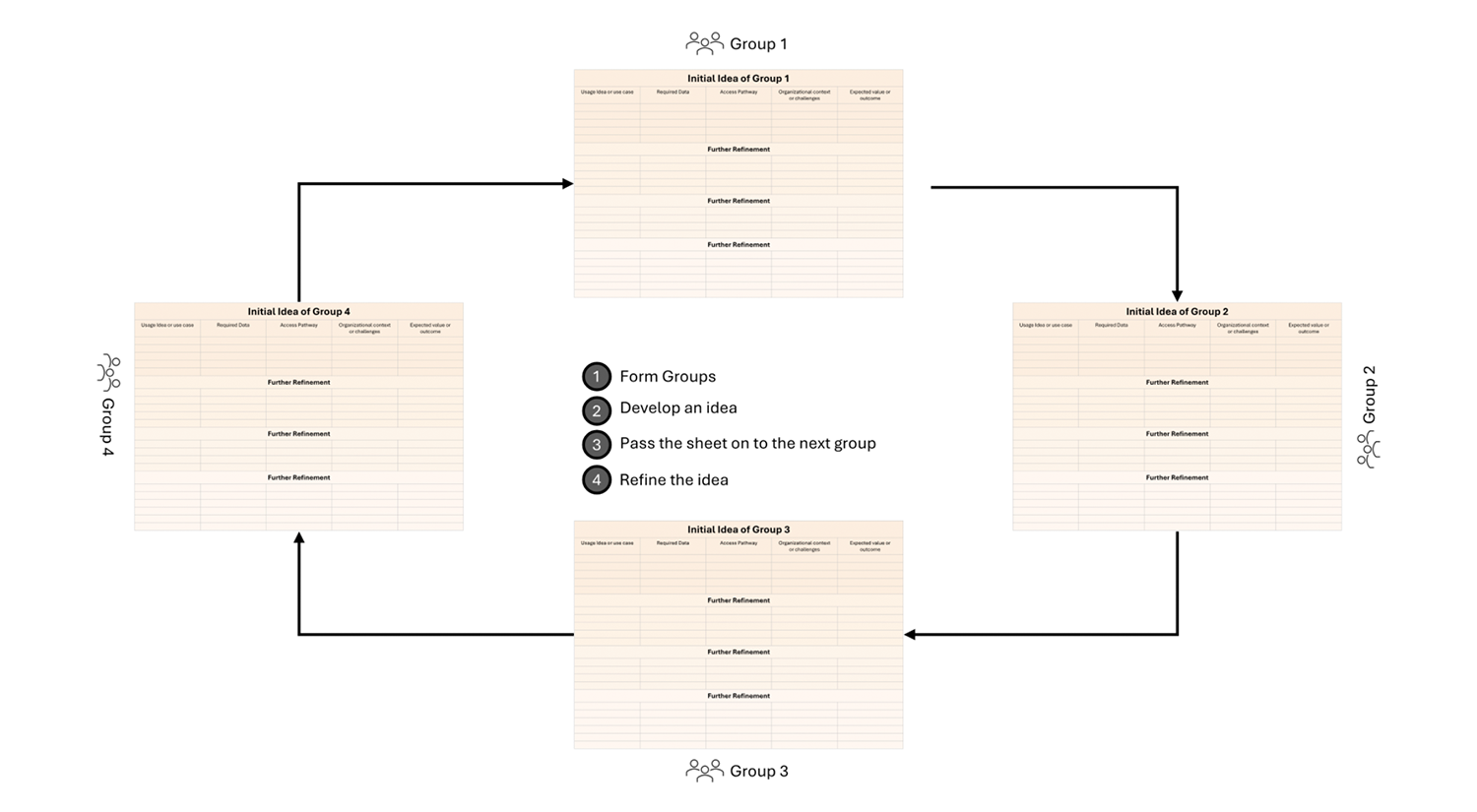
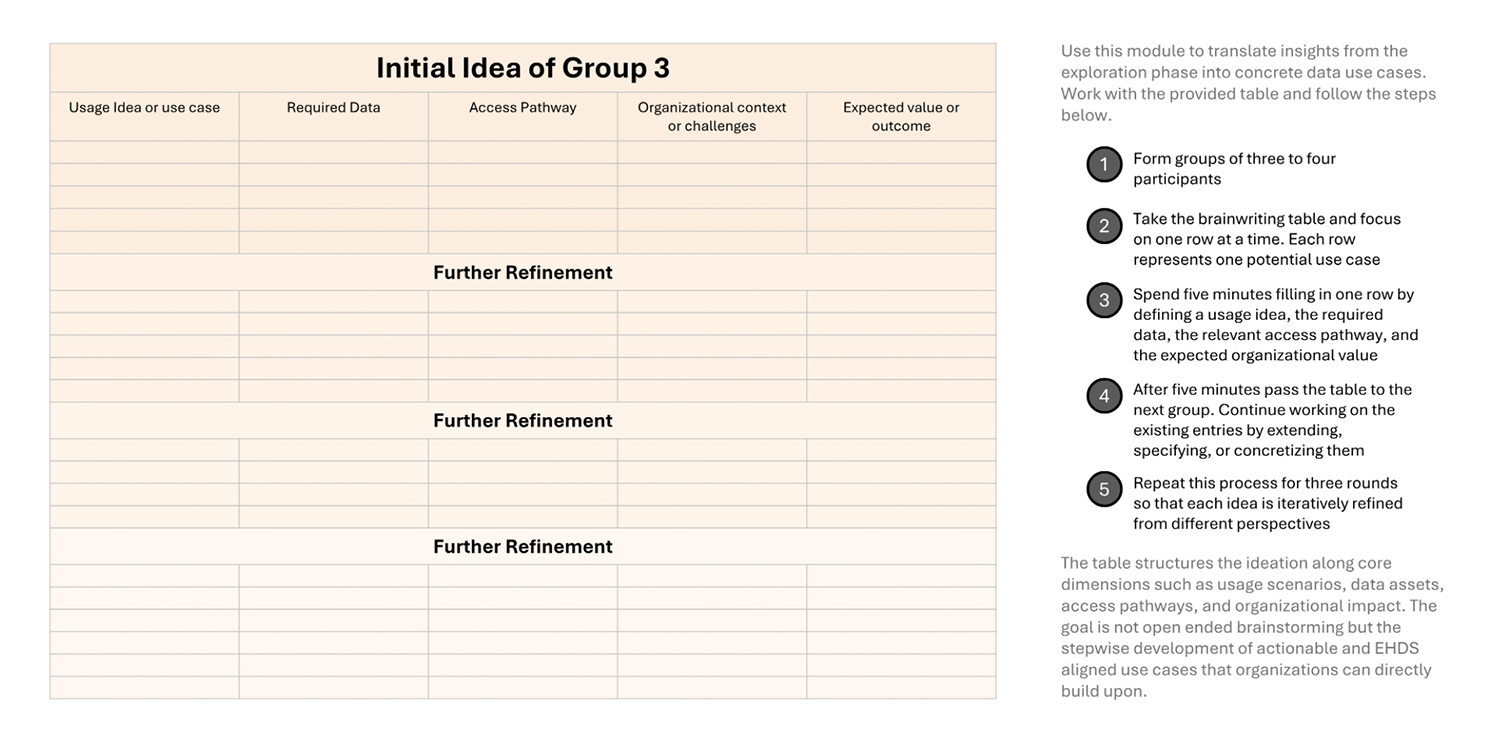
If possible, organize a short ideation session with a small group of key people from your organization. Ideally, bring together around six participants who work closely with data, products or innovation activities. This may include roles such as data analysts, product owners, researchers or domain experts. In many cases, the collaborative brainwriting approach works particularly well because participants can build on each other’s ideas and perspectives.
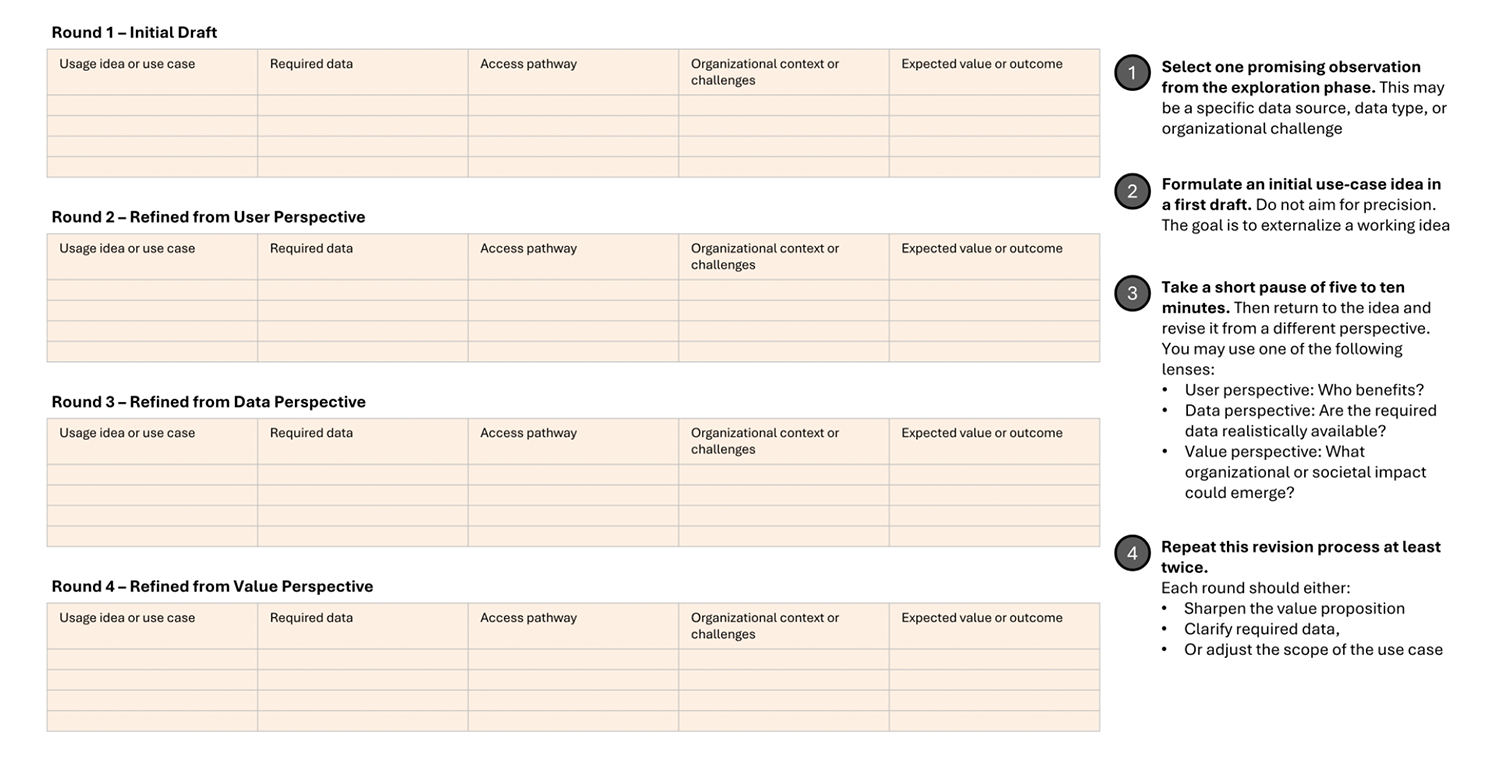
If organizing a group session is not feasible, you can alternatively use the trigger-based brainstorming canvas to stimulate ideas individually or in a smaller group. You can also work with the individual ideation canvas to develop ideas on your own.
All formats pursue the same goal. They help you translate the insights from the exploration phase into concrete data-driven usage ideas. Choose the format that best fits your organizational setting and available resources.
Action module: Open Brainwriting
One of the methods applied in the ideation phase is open brainwriting. This method supports the written generation of ideas while deliberately prioritizing the substantive formulation of usage ideas over their formal classification. The originally known format of brainwriting is the so-called 6-3-5 method introduced by Rohrbach in 1969, in which six participants each develop three ideas within five minutes and iteratively pass them on for further refinement. This classical configuration serves as a methodological reference rather than a strict requirement.
In practice, brainwriting formats are frequently adapted to the specific context, problem domain, and organizational setting in which they are applied (VanGundy, 1988; Paulus & Nijstad, 2003). In the present framework, the method has therefore been adapted explicitly to the development of data use scenarios. Instead of generating abstract solution ideas, participants are guided to formulate concrete data-driven usage concepts grounded in the results of the preceding exploration phase. This adaptation ensures that ideation remains aligned with identified data types and organizational objectives while preserving the creative and divergent character of the method.
Accordingly, brainwriting can be adjusted with regard to group size, timing, and thematic focus without compromising its underlying logic. In this process, open brainwriting is particularly suitable because it allows the exploration results to function as a cognitive reference framework while still leaving sufficient space for preliminary, incomplete, or deliberately vague ideas. Creative thinking is therefore encouraged without prematurely introducing rigid structuring or evaluative logic into the ideation phase.
Collaborative Ideation Canvas
Individual Ideation Canvas
Action module: Trigger-Based Brainstorming
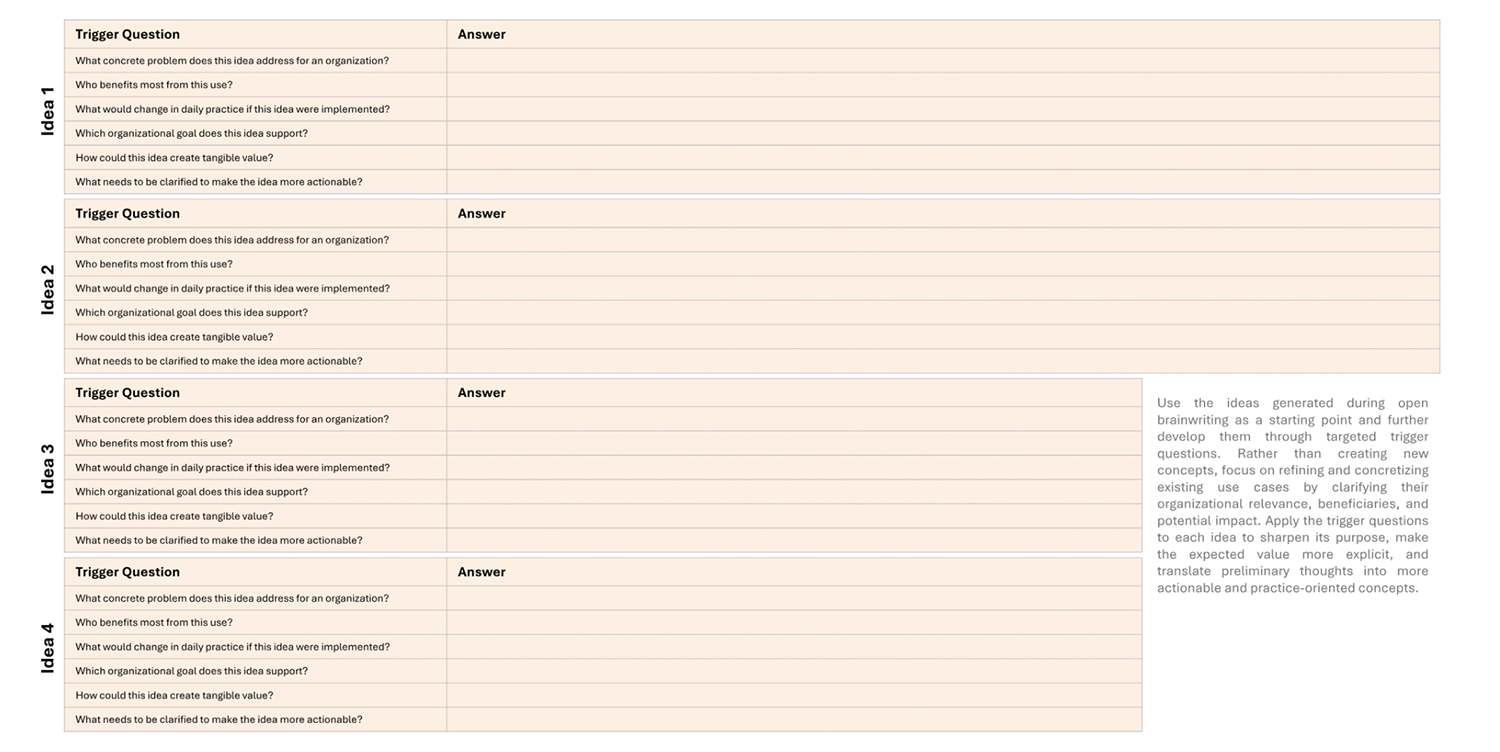
In addition, you can use trigger-based brainstorming to expand the range of possible ideas. This method works with targeted prompts that help you look at the topic from different perspectives and further develop your ideas.
In this context, the data types, use cases and access pathways identified during the exploration phase serve as practical starting points for reflection. Guiding questions help you think about how these elements could come together in concrete usage scenarios for your organization. At the same time, the questions encourage you to consider the different roles of citizens, data holders and the EHDS when developing ideas.
In this way, trigger-based brainstorming helps you deepen and refine your ideas while still building directly on the insights from the exploration phase.
Action module: Develop for data-driven use cases
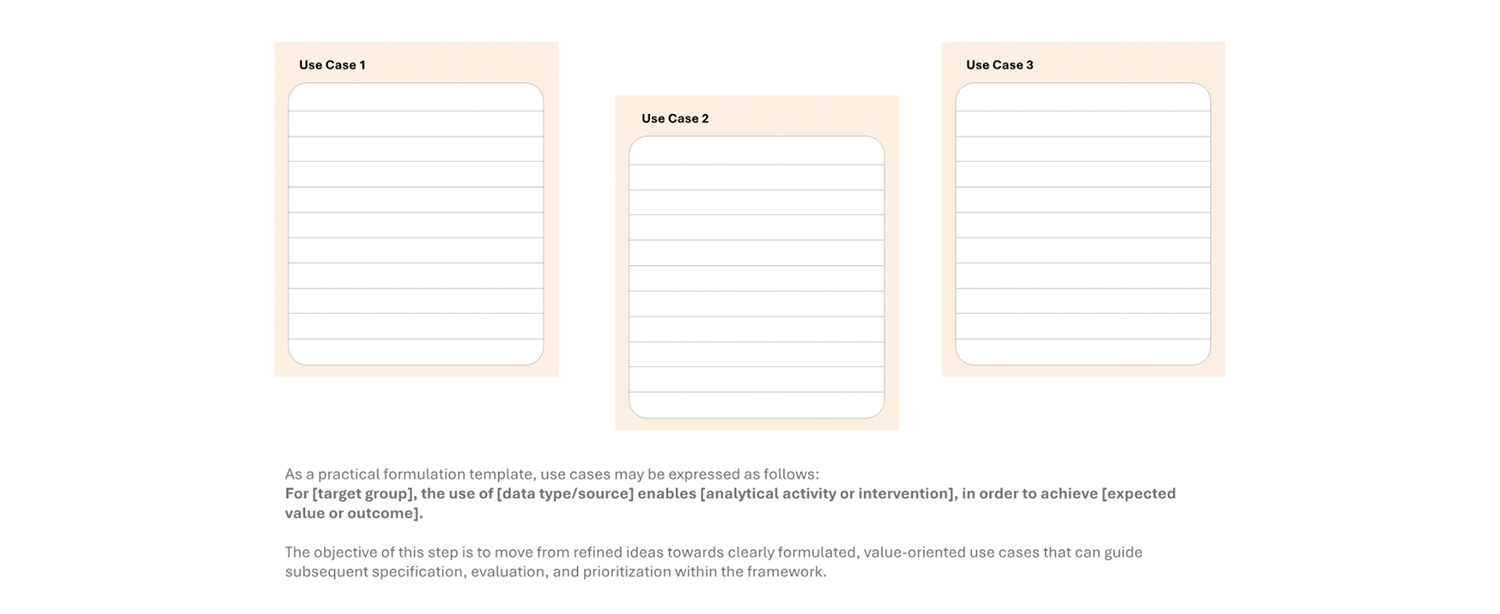
Use the ideas developed during open brainwriting and further specified through the trigger-based questions to derive concrete use cases. Review the refined ideas and identify those that have become sufficiently clear and meaningful through the previous steps.
At this stage, the transition from idea to use case requires a structured articulation. Innovation and business model research emphasize that early concepts gain analytical clarity when they are expressed in value-oriented form (Osterwalder & Pigneur, 2010). A use case should therefore not merely describe a topic or analytical intention, but explicitly connect data, action, and expected value creation.
To achieve this, transform refined ideas into concise use case statements that articulate:
- the target group or beneficiary,
- the relevant data basis,
- the intended analytical activity or intervention,
- and the expected organizational or societal value.
This structure aligns with established principles of value articulation in platform and ecosystem contexts, where value emerges through the purposeful combination of data resources and actor-specific needs (Tiwana, 2013). It also reflects design science guidance that artifacts should be described in a way that clarifies both purpose and utility (Gregor & Hevner, 2013).
Data-to-Use-Case Alignment
Work through each developed use case individually and assess which of the data identified during the exploration phase could meaningfully support it. Reflect on how the explored data landscape connects to the application scenario, document clear links between available data and the intended use, and highlight overlaps, blind spots, or missing data that still need attention. This step helps you connect exploration and ideation more systematically, strengthen the grounding of your use cases in the analysed data context, and identify where further refinement is needed.
References
Dell’Era, C., Magistretti, S., Candi, M., Bianchi, M., Calabretta, G., & Stigliani, I. (2025). Design thinking in action: A quantitative study of design thinking practices in innovation projects. Journal of Product Innovation Management.
Gregor, S., & Hevner, A. R. (2013). Positioning and presenting design science research for maximum impact. MIS Quarterly, 37(2), 337–355.
Osterwalder, A., & Pigneur, Y. (2010). Business model generation: A handbook for visionaries, game changers, and challengers. Wiley.
Paulus, P. B., & Nijstad, B. A. (Eds.). (2003). Group creativity: Innovation through collaboration. Oxford University Press.
Rohrbach, B. (1969). Kreativ nach Regeln – Methode 635, eine neue Technik zum Lösen von Problemen. Absatzwirtschaft, 12, 73–75.
Rösch, N., & Tiberius, V. (2023). Design thinking for innovation: Context factors, process, and outcomes. University of Potsdam.
Runco, M. A. (2014). Divergent thinking, creativity, and ideation. In M. A. Runco & J. C. Kaufman (Eds.), The Cambridge handbook of creativity (pp. 385–401). Cambridge University Press.
Tiwana, A. (2013). Platform ecosystems: Aligning architecture, governance, and strategy. Morgan Kaufmann.
VanGundy, A. B. (1988). Techniques of structured problem solving (2nd ed.). Van Nostrand Reinhold.